

Why Women With ADHD Are Wired for Compulsive Spending
I used to impulsively spend, to the point where the debt had slowly crept up to $24,000. That might not sound bad, but on a single income, with 4 small kids, it was overwhelming, to the point of tears. It stemmed from boredom, loneliness, stress, and even excitement. I would go shopping to fill a void that I had. Little did I know I had ADHD, and with it, a dopamine deficit I didn’t even know I was trying to fill. I wasn’t bad with money; I was looking for something to boost my mood.
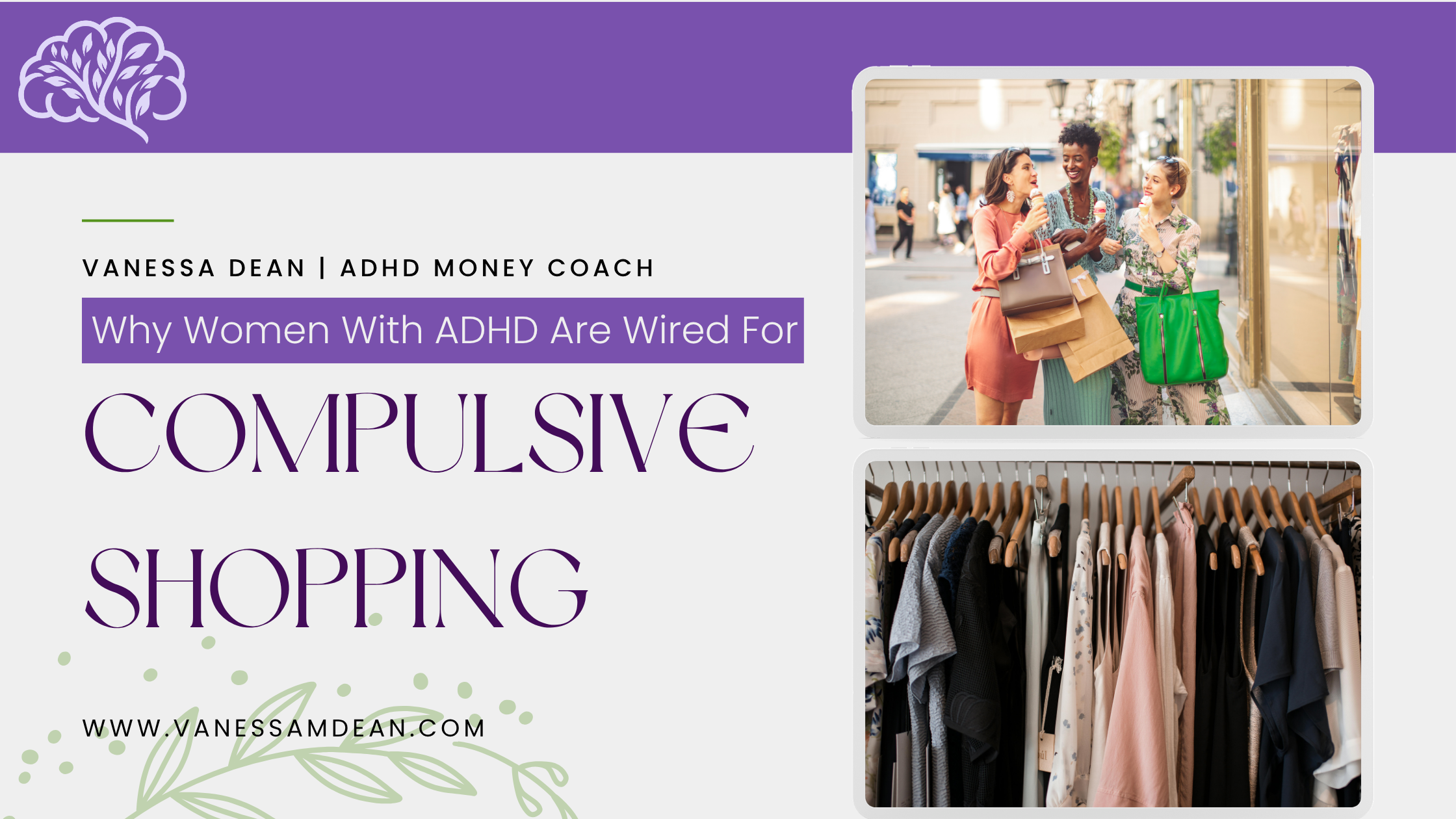
What I’m here to talk about, though, is bigger than impulsive spending, but compulsive spending. Where shopping is more like an addictive behavior. Research shows that it is driven by specific emotional and neurological triggers.
Compulsive shopping is the inability to control the urge to shop, even when it causes harm: financial, emotional, or relational.
The Personality Traits That Predict It
Researchers wanted to know whether certain personality traits make someone more likely to shop compulsively.
The answer is yes.
A study looking at “dark” human traits found four that consistently predict out-of-control shopping:
Anger. Spending as release. When emotions feel too big to hold, a purchase offers a moment of control. It’s reactive. It’s fast. And it works, temporarily.
Envy. Buying to close the gap. Seeing what others have and feeling the sting of not having it. Shopping becomes a way to level the playing field, at least in your mind.
Gluttony. More is never enough. There’s no natural stopping point. One item becomes five. A browse becomes a cart. The threshold keeps moving.
Pride. Shopping as self-worth. Purchases become proof of value, to yourself and to others. What you own reflects who you are.
Thankfully, they also found two traits that predict against compulsive Shopping.
Personality Traits That Protect Against Compulsive Shopping
Not every personality trait pushes toward compulsive spending. Two actually work as a buffer.
Conscientiousness. The ability to pause, plan, and follow through. People high in this trait are organized and self-regulated. Before spending, there’s a natural internal check, do I need this? Can I afford this? It actually works.
Agreeableness. The ability to consider consequences and self-correct. People high in this trait are socially aware and emotionally regulated. That awareness creates a natural brake before impulse becomes action.
The Trait That Amplifies Everything
Neuroticism is the tendency toward emotional instability. It shows up as anxiety, sadness, anger, and an intense reaction to stress. People high in neuroticism don’t just feel emotions; they feel them harder, longer, and with less ability to recover quickly.
And when it comes to compulsive shopping, neuroticism doesn’t just predict it.
It amplifies everything.
The darker traits hit harder. The protective traits matter less. The spiral moves faster.
Why? Because compulsive shopping is, at its core, an emotional regulation strategy. When emotions feel unmanageable, spending offers instant relief. The higher your neuroticism, the more you need that relief, and the harder it is to stop once you’ve found it.
Why ADHD Removes the Brakes
Why ADHD Removes the Brakes
ADHD isn’t just about focus. At its core, it’s a self-regulation disorder.
And self-regulation is exactly what you need to stop compulsive spending.
ADHD produces a specific personality profile — not by chance, but because of how it affects the brain. Three traits in particular:
Low Conscientiousness. Driven by inattention. The natural pause before a purchase, do I need this? Can I afford this? Requires planning, organization, and follow-through. ADHD makes all three harder. The buffer is weaker. Sometimes it’s not there at all.
Low Agreeableness. Driven by hyperactivity and impulsivity. The brake that says wait before acting on an urge? Impulsivity overrides it. Fast. Every time.
High Neuroticism. ADHD brains experience emotions more intensely. Anxiety, frustration, rejection; it all hits harder. And compulsive shopping is one of the fastest ways to get relief.
Add dopamine to the mix. Shopping is stimulating. It’s novel. It delivers an immediate reward. For an ADHD brain that is constantly seeking dopamine, that pull is not a preference.
It’s neurological.
Why Women Specifically?
Women with ADHD are already working at a disadvantage.
Most were diagnosed late — if at all. ADHD in women presents differently. It’s quieter. More internal. Easier to miss. So for years, sometimes decades, they managed without answers.
What they got instead was shame.
Too emotional. Too impulsive. Too scattered. Can’t hold it together. Bad with money.
Here’s what the research actually says.
Women with ADHD have significantly higher rates of anxiety and depression than the general population. That means higher neuroticism, the trait that amplifies compulsive spending.
They already have low conscientiousness and low agreeableness, the exact traits that protect against it.
They have ADHD-driven dopamine dysregulation, and shopping is cheap dopamine.
Every risk factor is stacked. Every protective factor was removed.
Nobody told them this was neurological.
They just thought they were bad with money.
Want to Know How Your Brain Spends?
So what was I left to do? But create a quiz with all the information.
Hit the button below to find out “What Type of Spender Are You.”
Until next time,
From Chaos to Control,
Vanessa